
Kitchen finishes explained: choosing doors and worktops
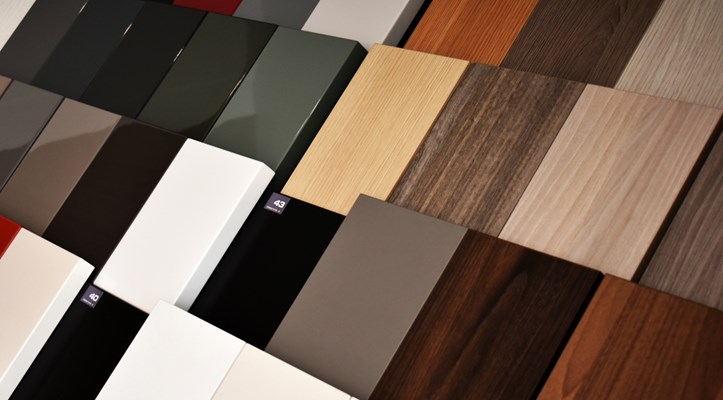
A worktop looks different once it sits beside the cabinet doors, flooring and wall colours. That pale grey you liked on its own might look blue next to a warm oak floor. A heavily patterned surface might compete with the timber grain you have already chosen.
Start with samples you can put together. Then consider how those surfaces will cope with cooking, spills and cleaning. Here is what to look for when choosing kitchen door finishes and worktops.
What is the difference between a material and a finish?
The material is what a surface is made from; the finish describes its appearance or treatment.
Wood veneer, for example, is a thin layer of real timber bonded to a supporting panel. Wood-effect laminate uses a decorative surface to reproduce the look of timber. Both bring a wood pattern into the kitchen, but they feel different when you handle them.
Matt and gloss describe how a surface reflects light. They do not tell you what lies underneath or how much maintenance it needs.
Choosing kitchen door finishes
Wood veneer: real grain across your cabinetry
Wood veneer brings natural grain into a contemporary kitchen. It works particularly well alongside plain doors, where the timber provides detail without every surface competing for attention.
Look at more than a small swatch. The direction and arrangement of the grain become much more noticeable across tall cupboards or a long run of doors. Ask how it will appear in the finished design.
Veneer is real wood, so the protective coating matters. Wipe away splashes promptly, particularly around sinks, and use the cleaning products recommended for the finish.
Laminate: look closely at texture and edges
Laminate offers plain colours, patterns and wood or stone effects. The difference between samples is often easier to feel than to see in a photograph.
Run your hand over the surface and look at the edge. Does the texture follow the printed grain? How does the edge sit against the face of the door? These details deserve attention because you will see and touch them every day.
FENIX: a soft-touch matt surface
FENIX has a very matt appearance, a soft feel and anti-fingerprint properties. Its low reflection makes it an option worth exploring if you dislike shiny cabinetry.
Superficial micro-scratches can be thermally healed using the manufacturer’s procedure. Deeper scratches and damage are a different matter: this is a useful property, not a promise that the surface repairs itself.
Matt or gloss kitchen doors?
Choose gloss if you enjoy reflections and a more polished appearance. Choose matt if you want less reflected light across the cabinetry.
Do not rely on gloss alone to make a dark kitchen feel brighter. Lighting, layout and colour need to work together.
For cleaning, compare the actual samples. A dark door under strong side lighting reveals marks differently from a pale door in softer light. Handle the samples and look at them upright before deciding. “Matt” or “gloss” alone will not tell you how visible fingerprints will be.
Choosing kitchen worktops
Solid wood
Solid wood brings grain and warmth to the work surface, but it comes with a maintenance commitment.
An oiled worktop needs its protective treatment replenished, with particular attention around the sink. Use boards for chopping and protect it from hot pans.
Choose it because you like timber enough to look after it. If scratches and changes in colour will frustrate you, explore another material.
Engineered stone and mineral surfaces
These surfaces offer everything from quiet, consistent colours to large, sweeping veins.
With a patterned worktop, ask to see the design at slab scale. A small sample might contain one fine vein while the full slab has a much bolder pattern. Discuss where that pattern will fall around the sink, hob and joints.
Quartz-based surfaces are familiar options, while newer formulations differ. Silestone, for example, is described by Cosentino as a low-silica hybrid mineral surface. Its care guidance recommends trivets for hot cookware.
Solid surface, including Corian
Solid surface is useful when you want a smooth appearance with discreet joins. Corian is one well-known example.
Look carefully at colour as well as shape. Corian’s guidance notes that dark, heavily pigmented colours show scratches and everyday wear more readily than lighter, textured colours. Chopping boards and protection beneath hot pans remain essential.
Ultra-compact surfaces, including Dekton
Dekton offers high resistance to heat, stains and scratches. It belongs in a separate category from quartz-based worktops and Corian.
Pay attention to edges and thickness as well as the face of the slab. Accidental knocks can chip edges, and Cosentino recommends protection from prolonged heat exposure, particularly for thinner surfaces.
Granite
Granite brings natural variation to the kitchen. View the slab where possible so you know which markings and colours you are choosing.
Ask about the treatment already applied and whether sealing is needed. There is no useful blanket rule that every granite worktop needs sealing annually; the advice should relate to your particular stone.
Marble
Marble needs careful thought in a working kitchen. Lemon juice, vinegar and other acidic ingredients can etch the surface, leaving dull marks. Sealing does not prevent that reaction.
If you want the surface to remain pristine with little attention, marble is a poor fit. Choose it with a clear understanding of the care and visible wear involved.
Stainless steel
Stainless steel gives a kitchen a distinctive, professional appearance. Scratches and fingerprints are part of the decision, so look at a used surface as well as a new sample.
Be honest about what you expect it to look like. If every visible mark will bother you, that matters more than how appealing it looks in a photograph.
Laminate worktops
Laminate offers a broad choice of decorative finishes and is worth comparing when allocating your kitchen budget.
Check the edge profile and where joints will sit, especially near wet areas. Proper sealing protects vulnerable edges and joints from moisture. Use chopping boards and heat-resistant mats to avoid damage from knives and hot cookware.
Bringing doors, worktops and flooring together
Give one surface the lead. Strong worktop veining is easier to appreciate beside quieter cabinetry; prominent timber grain often works well with a simpler worktop.
Put your samples beside the flooring and wall colours. Look for undertones: a grey with a blue cast can sit awkwardly beside warm beige, even though both looked neutral separately.
In an open-plan room, include the adjoining furniture and flooring in that comparison. You will see the kitchen from the sofa and dining table as well as from the hob.
Keep doors upright and worktop samples flat. Check them in daylight and under your planned lighting. This gives you a much better basis for choosing than a collection of separate images.
Explore finishes at Arrital Kitchens
Bring your ideas, plans and any flooring or colour samples to our Plymouth showroom. We can help you compare door finishes and worktop materials alongside the layout and practical requirements of your kitchen.
Browse our finishes and completed projects, or call 01752 787131 to arrange a conversation.
You May Also Like
How "tech" is your kitchen
Modern kitchens have dramatically moved on from the days when a microwave was seen as a new innovation...
Feeling warm in your kitchen
Feeling warm in your home isn’t just down to heating... At the end of this month, the clocks will go...
Arrital Kitchens are now AEG Premier Partners
Knowledge, Experience & Peace of Mind Choosing the right appliances to complement your new kitchen...